Blog

About Applied Positivity Enterprise Sdn Bhd

“A Posse Ad Esse”
(Latin for From Possibility to Reality)

“It is better to believe than to disbelieve; in so doing you bring everything to the realm of possibility” – Albert Einstein

Applied Positivity Enterprise Sdn Bhd, a private limited company, is very much a project-based company in training service sector (Education, Development and Skills Training) and is a Human Resource Development Fund (HRDF) Registered Training Provider in Malaysia. We use problem-based methodology of tripartite approach – what it is, what to do and how to do it; and customizing the training programmes that are relevant and complementary to the needs of education, mental health and safety system in Malaysia.

We put a lot of thoughts and effort into carefully constructing our evidence-based, specialist, holistic and integrated action-oriented project proposals. Dr S H Lua as the company’s Director of Training and Programme Development, is a driving force behind a dedicated, passionate and committed team. We are driven by a passion to produce and develop something unique, to change and transform people’s lives by making the impossible becomes the possible and that is when passion matters. It is the zest, the enthusiasm, the giving the little bit more, going extra mile no matter what, that makes real positive difference and open up so much of insurmountable opportunities and possibilities.

The question is ‘why not?’ as nothing ventured, nothing gained. To quote Charles Dickens, “The most important thing in life is to stop saying: ‘I wish’. And start saying: ‘I will.’ Consider nothing impossible. Then treat possibilities as probabilities.” ‘Why not’ in creating exciting and challenging opportunities and possibilities. ‘Why not’ in creating a sense of wellbeing, sense of belonging and enthusiasm. ‘Why not’ in creating M.I.N.D. (pronounced as individual letter) in dealing with psycho-social problems and issues. It is not a utopian philosophical position. It is a positive practical crucial position in understanding and training our mind to see the positivity in everything as being non-judgmental, for our minds are the major source of both our sufferings as well as fulfillment and happiness. It is important to relate what is going on inside us. Minds are like parachute. If they are closed, they would not hold us up. It is thinking of a clear, concise and unclouded mind that makes us what we truly are.

We utilise the concept of Wise Mind which is one of the three mind states that includes Emotion Mind and Reasonable Mind – the core components of Dialectical Behaviour Therapy (DBT). According to Dr Marsha Linshan, Reasonable Mind is considered as a logical and fact-based; on the other hand, Emotion Mind is ruled by emotions which can be impulsive thinking due to intense feelings and a sense of Its urgency. The Wise Mind is the balance of both Reasonable Mind and Emotion Mind where reason and emotion come together as a wholesomeness of mind and heart resulting in inner wisdom of a healthy state of mind – “there is a wisdom of the head, and a wisdom of the heart” (Charles Dickens). In order to uncover and have an access to the WISE Mind, we create an acronym M.I.N.D. within the powerhouse of the mind, i.e. what state our mind and heart are in when we are reacting and responding to the environment of struggles, challenges and obstacles. None of us are responsible for all things that happen to us, but we are responsible for the way we act when things do happen. To quote, Mahatma Gandhi, “Happiness is when what you think, what you say and what you do are in harmony.”

M.I.N.D. stands for:

M – MINDFULNESS/Awareness; for instance, we tend to spend so
much time worrying about tomorrow – what will happen?
What will I do? – that we forget about today – here and now.

“Do not look back. No one know how the world ever began.
Do not fear the future. Nothing lasts forever. If you dwell on
the past or the future, You will miss the MOMENT.”
– Unknown

I – IDENTITY/Self-as-context in knowing and understanding
deep-down who are you? How do you define yourself?
What makes you who you are?

“Identity cannot be found or fabricated but emerges from
within when one has the courage to let go.”
-Doug Cooper

N – NON-JUDGMENTAL as an age-old saying – don’t say ‘no’ and
don’t say ‘yes’. Acceptance is the key even though it is
painful, only then you can look at what is actually there in
front of you, now and here.It is Psychological Flexibility in
Openness, Acceptance, Engagement.

“Mindfulness is paying attention, on purpose, non-
judgmentally, in the present moment”
– Jon Kabat-Zinn

D – DIRECTION – Purpose/Values in life. Our life and identity
are often defined by something, some events, some
incidents, i.e. we are often defined by our job role or be
defined by our mental state. We need to define ourselves
by finding the values and directions in our life. Life is not
about speed. It is about direction – where are you going?
What is your purpose? Effort without direction is wasted
energy.

“Efforts and courage are not enough without purpose and
direction.”
– John F. Kennedy

We seek to become the frontline mental health and psychological wellbeing provider based on Acceptance and Commitment Training (ACTraining) and Focused Acceptance and Commitment Therapy (FACT) approaches by serving a widely diverse population / groups that can be applicable across the wide spectrum of problems and issues associated with stresses and burnout at workplace, primary care and school settings.
We have shred away from diagnoses, using non-pathology-driven and transdiagnostic approach, nonsydromal model, within a positivist and psychological paradigm. We hope to develop a blueprint for mental health with wellbeing orientation. Mental health is not a destination but a process – something we can sense but we can’t see. It is about how to
drive (process), not where we are going (destination). We need to focus on making ACTraining and associated FACT (Focused Acceptance and Commitment Therapy) training programmes accessible to all levels of professionals and general public, by increasing recognition of the importance of mental health awareness. ACTraining adapts Acceptance and Commitment Therapy (ACT) principles for non-therapeutic workplace settings.

Being a social enterprise company, we work and collaborate with government agencies to achieve social impact through creating a public-private partnership (PPP). We are taking positive initiatives to think of effective groups training in resilience and wellbeing preventive programmes and developing psychological flexibility that is the key
process for enhancing psychological health and values-oriented behavioural effectiveness by building resilience and empowerment to thrive in the workplace.

We design, implement and evaluate the effectiveness of Resilience Skills Training (RST) for children and young people in schools (SALUS Programme); ACTraining for teachers, employees, managers and leadership training in the workplace (HRDF Training Programme), and ACTraining and FACT programmes for medical residents under the
Housemanship Training Programme, practitioners, primary care professionals.

We have also implemented our Alternative Positive Therapeutic Education based on 3Ts Programmes (Teaching, Training, Therapy) that focus children and young people’s strengths, interests and needs in achieving confidence, integrity and excellence, rather than lashing out their ‘labelled’ self and often than not being bogged down in the labelling process.

These training programmes are more demand driven in the 21st century way of dealing with our thoughts and emotions by being resilience and discovering our inner self which is at the root of our problems, i.e. who we really are, not necessary what people think we are – personal empowerment in responding to the ever-changing and unpredictable,
volatile 21st century. If we can go deep into ourselves, by opening up inwardly in ourselves, we will find we possess exactly what it is we desire. As stated by the Foresight Report on mental capital wellbeing project 2008 (UK), “Making the most of ourselves in the 21st century”, in dealing with stress and burnout issues as a 21st century syndrome. In doing so, we aim to utilize the concept of ‘sisu’ (the Finnish art of inner strength). ‘Sisu’ in Finnish means strength, perseverance in dealing with difficulties and challenges since we are battling with our own mind every single day.

Download: Applied Positivity Enterprise Sdn Bhdompany – Company Profile
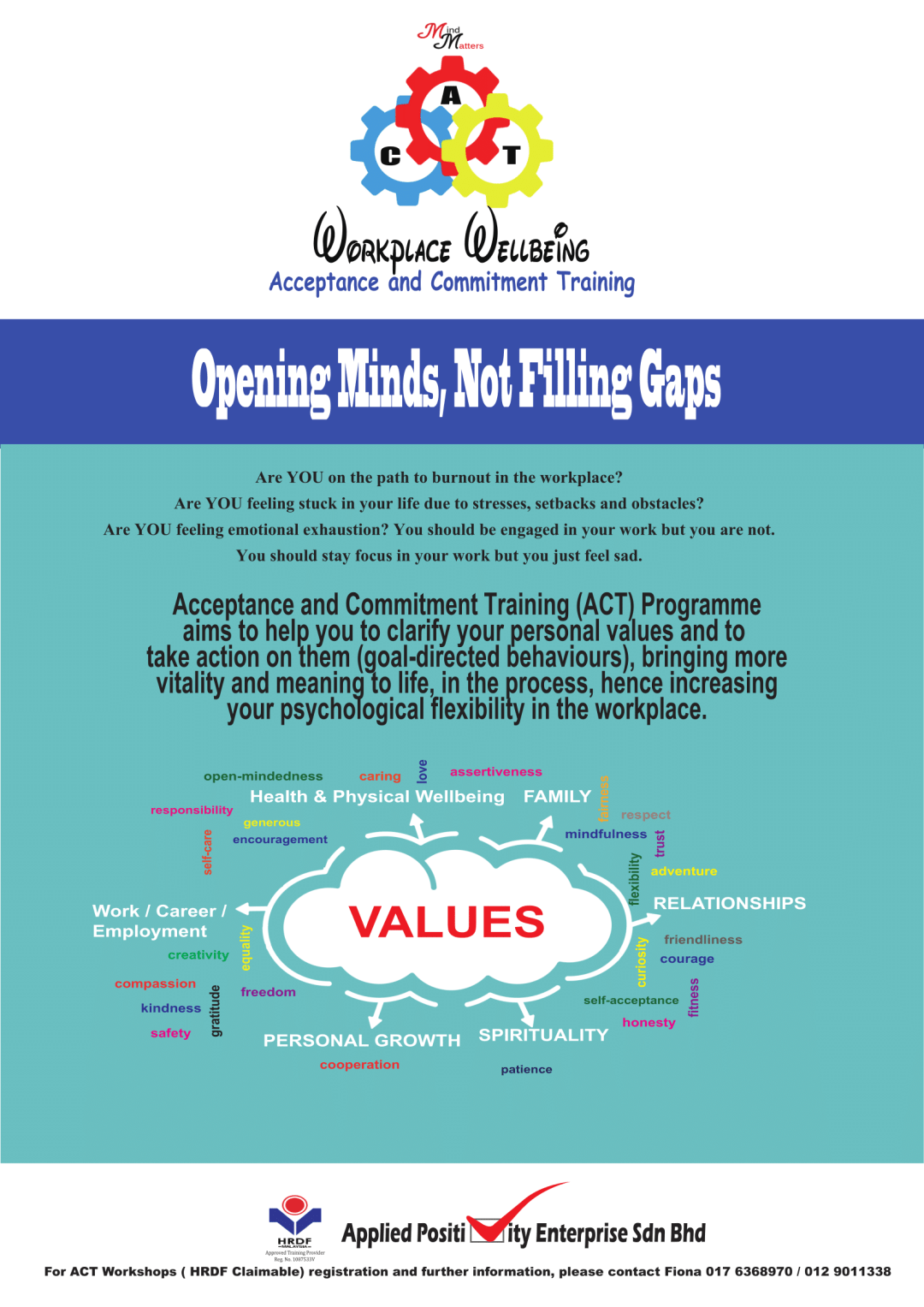
SALUS Programme “Opening MINDS, Not Filling GAPS”

Adventure and Outdoor / Indoor Camping

Our education system places great emphasis on acquiring knowledge, relying solely
on the acquisition of knowledge and examinations. We must also focus on children
and young people’s wellbeing as a ‘person’ with their needs, worries, anxieties.

Our children and young people are better when they open up and share their
thinking and emotions than when they think and feel alone or when they are being
told what to do. It is not going to be an easy process but it is going to be worth it!

As we are now in the 21st century, our children and young people face the
challenges and pressures of achieving academic excellence, often at the expense of
their mental wellbeing, either in acting and reacting without thinking or keeping
thinking without acting. The problem gets so large and significant as a plethora of
interesting and concerned issues arise in the digital age of the 21st century. We
should not just sugar-coat the consequences. We need to understand and create
awareness of mental health issues among children and young people as one of the
central challenges in the 21st century.
Adventure and Outdoor/Indoor Camping Activities offer add-on value to our children
and young people’s personal development by experiential learning in outdoor
learning environments, instead of classroom / school curriculum structured learning
environment. In pursuit of organized outdoor/indoor camping activities in campsite
including rope courses, group games, tent camping (pitching a tent and sleeping
there for one night), these external activities provide students enjoyment, fun and
opportunity to learn teambuilding and responsibilities, usually they are assigned
responsibilities.

Questions raised:

  • Can children and young people (CYP) really have a genuinely educational
    experience from Adventure and Outdoor /Indoor Camping?
  • Can Adventure and Outdoor/Indoor Camping help children and young people to
    acquire life skills on how not just survive but to flourish and thrive in schools?
  • How have children and young people dealt with their anxious thoughts and
    feelings in order to stay focused and collected?
  • What can we do to fix our failing education system in preparing children and
    young people to thrive in schools in tune to changes of the 21si century as
    ‘school typically does not prepare young people for real life.’ (Ray Dalio)

There is often a disconnection from our education system and the real world. Our
children and young people need to start asking themselves what they want to
achieve in their life. They need to create and constantly working on themselves as
Warren Buffett said, “The best investment you can make is an investment in
yourself.”

What is it all about?

  • 2 days 1 night Camping Activities serves as a doorway into self-discovery. The
    camping aims to create an outdoor experiential learning of optimism, hopefulness
    and positivity by being:

    • Practical
    • Realistic
    • Transformation
  • As a follow-up to the camping activities, applied psychologist Dr S H Lua and a team
    of trained mentors will present and share practical, realistic and transformative
    approach so that attending the camping is a worthy endeavor for children and young people.
  • Within a limited and short span of camping time, they will discover for themselves in their ability to make a first small step toward behavioural change.
  • It is common for our children and young people to believe that they cannot do, even without trying. During camping, they can have ‘aha’ experience for they are capable of so much more than they ever realize and aware of, only if they can focus in defining what matters most to them.
  • Change only occurs when children and young people are aware and notice of what is happening within their own selves. During the training camping session of practice and role-play, they gain insights into themselves – how they perceive, learn, feel, think and act. Even though it is a slow process of change, the momentum of change will energize children and young people to keep going and moving forward.

Camping Learning Outcomes – “aha’ experience

  • ‘Aha” That is how it is done in changing children and young people’s thinking habits
    for the better. To acquire life skills in developing a broader and deeper perspective
    of self as a ‘person’ through experiential learning:
    – a sense of responsibility and accountability
    – a sense of accomplishments / achievements
    – a sense of resilience and self-reliant
    – a sense of independence in self-esteem and self-confidence
    – a sense of belonging
  • By acquiring the ‘aha’ experience of what they do during the camping, children and
    young people will be able to see and experience in their self-discovery journey – the
    difference between who they are and who they want to be. They will learn to: (i)
    never let the things they want make them forget the things they have; (ii) they must
    do the thing they think they cannot do and if they want it, they have to put an effort
    and work for it; and (iii) they are always responsible for how they act, react and
    behave, no matter how they feel.

Download: SALUS Programme “Opening MINDS, Not Filling GAPS”

Acceptance and Commitment Training (ACTraining) in the Workplace

What is ACTraining?

  • ACTraining serves as a starting off point on a self-discovery journey that will
    take you further in your life of who you really are and what you want in your
    life.
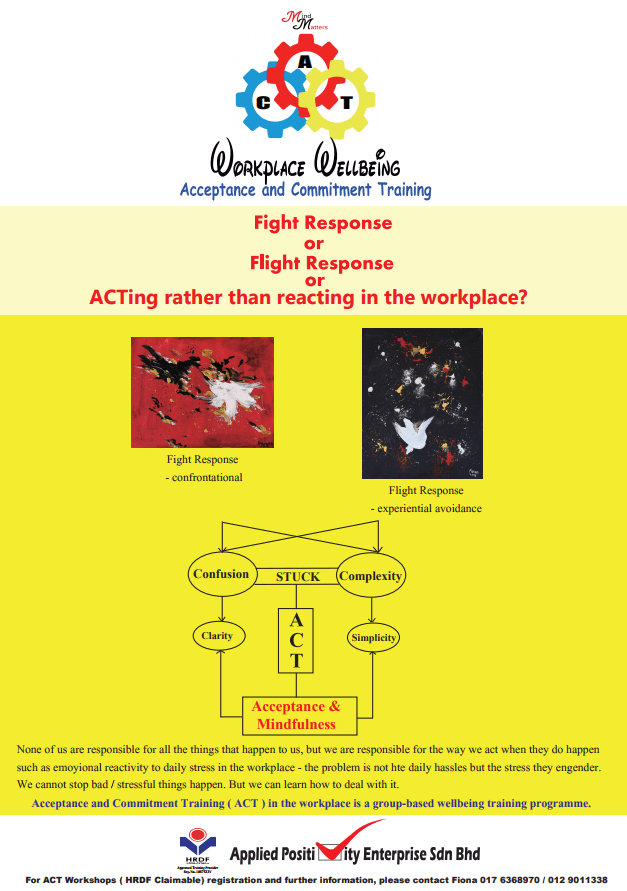
  • ACTraining is not to stop mental distress of anxieties, fears, worries from happening but to help employees deal and cope better under such
    circumstances. In doing so, they will be able to recognize their own potentials
    and strengths.
  • How people management can enhance job performance outcomes
    • Skills for improved productivity, employment growth and development
    • Serves as personal growth in the workplace

Why ACTraining in the workplace?

  • WHO Healthy Workplace Framework and Model
  • Fundamental question of what kind of the workplace we would like to work
    in – from where we are to where we want to be.
  • What is a healthy workplace
  • Workplace diversity
    • to promote individuality within the workplace
    • to acknowledge every employee can bring something different to the
      workplace
    • to nurture and develop the potential of each individual in the
      workplace
    • to provide strategies to deal with social issues of 21st century in the
      workplace

Psychological Well-being in the Workplace

  • Able to enhance a diverse workforce and working with a diversity perspective
  • Helps to implement diversity within the workplace “A Culture of Diversity”

Is there a need for change in the workplace?

“This is how it has always been done. Why change it?’

– How would you THINK?
– How would you FEEL?
– How would you ACT?
– What would you SAY?

The ques on of “What if”

  • What if employees are trained and taught to be emotional resilience, i.e. so life skills that ma er as much as technical and job skills?
  • What if employees are competent in their work and yet they are unhappy, sad and depressed and s l worry about their future?
  • What if employees with better emotional well-being can do better in the workplace?
  • What if emotional and resilience skills are learned skills that can be
    acquired?
  • What if we can instill and promote emotional and resilience skills in
    employees in workplace?

Download: Acceptance and Commitment Training (ACTraining) in the Workplace

Training Course

Training Course 1

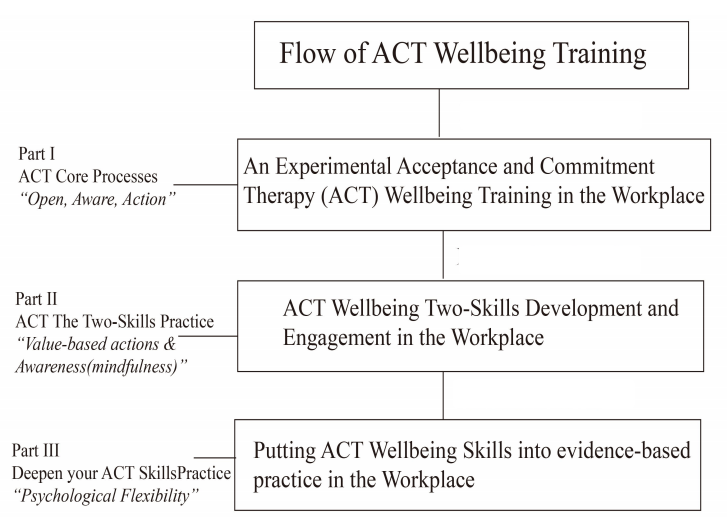
“An Experiential Acceptance and Commitment Therapy (ACT) Wellbeing
Training in the Workplace”

Duration: 2 days
Time: 9am – 5pm
Venue: OWG No.10. Jalan Pelukis U1/46, Seksyen U1, Temasya Industrial Park,
Glenmarie, 40150 Shah Alam, Selangor
Refreshments: two tea-breaks (morning and afternoon) and lunch
Training Course Fee: HRDF Claimable. Call us for details.
Average number of participants: 10 – 15
Training Dates:
(1) 13th & 14th December 2017 (Wednesday & Thursday)
(2) 23rd & 24th January 2018 (Tuesday & Wednesday)
(3) 6th & 7th March 2018 (Tuesday & Wednesday)

Please kindly call us for further details regarding the training dates throughout the
year 2018.

Training Course 2

“Acceptance and Commitment Training (ACT) Wellbeing Two-Skills
Development in the Workplace: Value-based Committed
Actions and Awareness/Mindfulness”

Duration: 2 days training
Time: 9am – 5pm
Venue: OWG No.10. Jalan Pelukis U1/46, Seksyen U1, Temasya Industrial Park,
Glenmarie, 40150 Shah Alam, Selangor
Refreshments: two tea breaks (morning and afternoon) and lunch
Training Course Fee: HRDF Claimable. Call us for details.
Average number of participants: 10 -15
Training Dates:
(1) 5th & 6th February 2018 (Monday and Tuesday)
(2) 28th & 29th March 2018 (Wednesday and Thursday)

Please kindly call us for further details regarding the training dates throughout the
year 2018.

Training Course 3

“Developing Psychological Flexibility in the Workplace” Duration: 2 days training

Time: 9am – 5pm
Venue: Call us for details
Refreshments: two tea-breaks and lunch
Training Course Fee: Call us for details
Average number of participants: 10 – 15
Training Dates: Call us for details

For registration and further information, please kindly contact
Fiona 017 6368970 / 012 9011338

ACT Experiential Wellbeing Training Programmes in the Workplace

The three parts ACT protocol framework of training in the workplace provides an opportunity for participants to return and share their experiences of practice and skill application. ACT has been adapted to create a non-therapy version called Acceptance and Commitment Training to train and teach awareness (mindfulness), acceptance and value skills in non-clinical setting such as workplace (Hayes et al 2007); as the saying goes, “ Give a man a fish, and you feed him for a day. Teach a man to fish, and you feed him for a lifetime”.

ACT

What is Acceptance and Commitment Training( ACT )?

(ACT, pronounced as the word ‘act’)

ACT has the potential to promote and improve the work site mental health by application of psychological flexibility rather than using reactive approach of symptom reduction. ACT training programme is designed as a generic employee wellbeing skills training programme.

  • ACT serves as work site stress management training in experiential approach
    to behaviour change
  • ACT is applied not to change the form, intensity, frequency of undesirable
    thoughts and feelings but instead, to change how employees respond or relate to
    their internal events (thoughts and feelings) in order to live meaningfully – ‘open,
    aware, and active” lives.
  • ACT is adapted into a group-based training programme (Flaxman et al) to
    facilitate and cultivate the functional psychological and behavioral two-skills of
    (1) awareness (mindfulness); and (2) values-based action; in non therapeutic
    situations.
  • ACT is developed within a pragmatic philosophy called functional
    contextualism with emphasis that psychological well-being is determined by how
    the thoughts (cognitions) interact with the contexts/situations/environments either
    to help or hinder the ability to pursue values and goals.
  • ACT needs to be more accessible and available to employees as part of
    occupational health policy and practice.
  • ACT is based on the nature of human language and cognition (Relational
    Frame Theory – RFT), i.e. a comprehensive theory of language and cognition
    derived from behaviour analysis.
  • ACT teaches and trains individual employees to be aware (just notice), accept
    and embrace their private events including the unwanted thoughts, feelings;
    whereas traditional cognitive behaviour therapy (CBT) places emphasis on
    teaching individuals to better control their thoughts, feelings, sensations,
    memories and other private events.
  • ACT helps and enables individual employees to get in contact with a
    transcendent sense of self known as “self-as-context”. This means that the YOU,
    always there observing and experiencing and yet distance from one’s thoughts,
    feelings, sensations and memories.
  • ACT assumes that psychological processes of a normal human mind are often
    destruction (Harris, R. 2006) – psychological suffering; rather the ‘healthy
    normality” where by their nature, the processes of human mind are
    psychologically healthy.
  • Psychological suffering is caused by experiential avoidance, cognitive
    entanglement (cognition fusion) which then result in psychological rigidity that
    leads to a failure to take needed behavioral actions according to values and goals.

What is the objective of ACT?

According to Hayes et al (2012), the objective of ACT is not elimination of difficult feelings; rather, it is to be present with what life brings us and to move towards valued behaviour. ACT Experiential Training Workshops allow participants to “open up to unpleasant feelings, and learn not to overreact to them, and not avoiding situations where they are invoked. Its therapeutic effect is a positive spiral where feeling better leads to a better understanding of the truth” (Shpancer, 2010). ACT aims to help individual employees to clarify their personal values and to take action on them (goal-directed behaviour), bringing more vitality and meaning to life, in the process, hence increasing their psychological flexibility (Zettle, 2006)

Why is it important to improve your psychological well-being in the workplace?

Based on functional contextual development model, ACT has significant contribution and beneficial effects to workplace well-being:

  • positive mental health and psychological well-being
  • to maximize behavioral effectiveness i.e. performing well at work
  • job satisfaction
  • leadership development – to develop crisis-resilient change
  • quality of work life and fulfillment
  • emotional resilience
  • positive and good organisation behaviour management strategies and
    initiatives such as team and leadership development and career coaching
  • acceptance (flexibility) to experience unwanted private events instead of
    altering the form, frequency or sensitivity, in the pursuit of values and goals
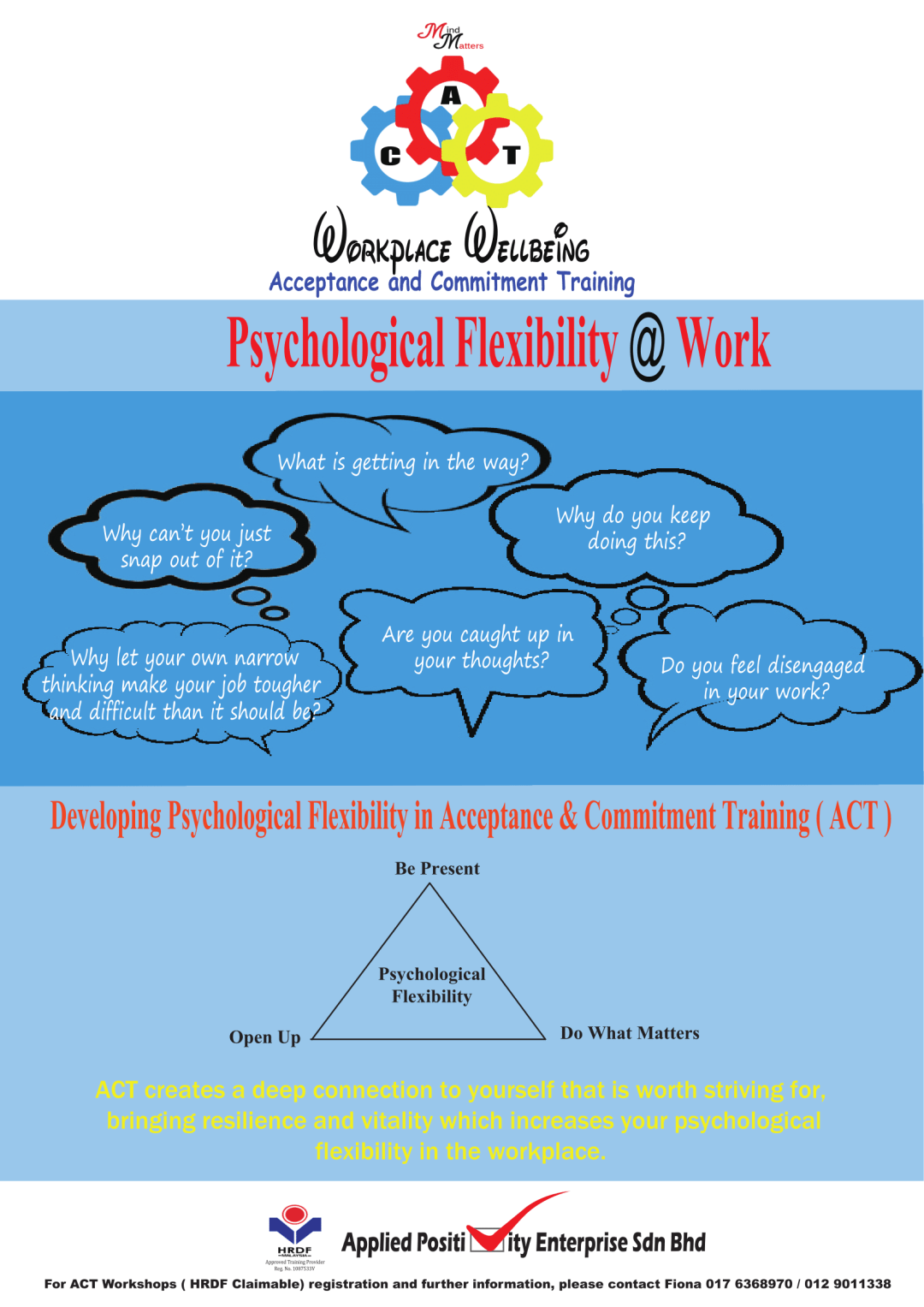
  • psychological flexibility (ACT’s core psychological process) – ‘the ability to
    fully contact the present moment and the thoughts and feelings. ACT training has
    been found to be useful on a personal level – knowledge and experiential training
    gained during the group format training have been useful to participants in their
    own life

What are the common and predominant mental and psychological issues and problems associated with work-related stress?

The prevalence of psychological distress and dysfunction in the workplace has been attributed to reduced and lost of work productivity, often placing financial burden on the organisations. The demands of working life have resulted in common mental health problems and issues related to stress in the workplace such as:

  • worries and anxieties about the future that things might go terribly, horribly
    wrong
  • feelings of inadequacy
  • out of touch with sense of purpose in life
  • excess work demands
  • professional burnout
  • associated occupational risks
  • Presentism in workplace, often resulting in reduced productivity – the practice
    of coming to work despite illness, injury, anxiety etc, working long hours at a job
    without the real need to do so due to manifestation of insecurity and fear about
    one’s job
  • absenteeism – absence due to sickness or personal issues
  • depression due to work-related stress
  • experiential avoidance (inflexibility)

What is the rationale for using ACT to promote psychological well-being and to enhance behavioral effectiveness and functioning in the workplace?

Workplace offers an ideal and effective context of improving individual employee’s psychological well-being since majority of employees’ work-related problems are not tackled nor dealt with – remain undiagnosed and untreated, just been swept under the carpet with increased sickness, absence and reduced productivity; unless help and support are delivered in the workplace. ACT serves as an experiential approach to behaviour change at workplace. There is a need and rationale to make ACT accessible and available to promote mental health and psychological well-being in the workplace. It has been stated in research that employees spend almost 60% of their waking hours (7/8 hours per day) at work. Hence it is rational and logical to use workplace as context for improving individual employee’s psychological well-being and quality of life.

We specialise in providing:

  • ACT Wellbeing Training Workshops in the workplace
  • ACT for Management Levels
  • In-house, tailor-made ACT Wellbeing Training Programmes
  • Intensive Focused Acceptance and Commitment Training (FACT) to fit in
    time demands

Acceptance and Commitment Training (ACT) is:

  • Fun
  • Interactive
  • Experiential
  • Real work practice to develop the psychological skills that employees need to function effectively and productively at work

“ It’s not hard to make decisions when you know what your values are”
– Roy Disney