


SALUS Programme: Transition from Primary to Secondary Level
“Opening MINDS, Not Filling GAPS”
2-day Training Workshop
Venue & Dates: To be coordinated later
Time: 9am – 4.30pm
Fee/Cost: To be discussed with interested parties.
(Certificate of Attendance, training materials, refreshments and lunch)
Participants: Standard Six pupils (Primary Schools)
Form One students (Secondary Schools)
Trainer/Facilitator: Dr S H Lua, DPhil (Oxford), AFBPPsS, CSci, FRSA, CPsychol
The 2-day Skill Training Workshop for 11+ & 12+ years old children including Std Six school children after their UPSR and Form One students, is founded on research, knowledge, experience, values and beliefs in what we know to be in the best interests of children during their developmental transition phase from primary to secondary level where they will change as adolescents. Adolescence (from Latin adolescence, meaning ‘to grow up’) is developmental stage in which adolescents will undergo substantial transformations in all aspects of their development – physically, psychologically, emotionally and socially which require them to acquire adjusting and adapting skills. The 2-day Skill Training Workshop is practical, real and relevant to the changes in a variety of emotional, social and behavioural needs that children experience during the transition phase. By having a choice, taking a chance, making a change creates a winning edge that makes a real difference to children’s development and growth.
What is it all about?
Get Std Six/Form One schoolchildren’s act together during the transition phase from primary to secondary level by attending this 2day training opportunity workshops. Come and experience, explore, enrich, educate, share and apply of what it is like didactically and experientially of why we think, act and feel the way we do in a real context, hands-on practice and feedback – “I hear and I forget. I see and I remember.
I do and I understand.
Transition from being primary school pupil to secondary school student can be stressful, as the schooling environment, learning demands and responsibilities are different. It Is not just about destination – moving to secondary school; it is also about the journey. So instead of being like a fish thrown out of water during the transition from primary to secondary level, our children should be, as the saying goes, “Give a man a fish and you feed him for a day. Teach a man to fish, and you feed him for a lifetime.”
Schoolchildren need support and guidance. They need to be engaged and involved during the transition change process. The 2-day training workshop will enable and empower children to make a smooth and positive transition from being a primary school student to secondary school student, with clarity and confidence, moving onward, upward and forward. A transformative positive training programme that represents our 21st century ways of dealing and coping with academic and emotions
challenges by being resilience.
The 2day training workshop focuses more on children for a moment, individually as a person. With a small group (20-25 children) in each training workshop, we will be able to take a truly experiential and personal approach in something different, relevant, interesting, fresh, fun by being wholesomeness in keeping children’s mentally and emotionally healthy to flourish and thrive at schools.
Bottom-up approach of training where there is a progressive from individual element to the whole during the transition from primary to secondary level. This involves: (i) adaptation; (ii) flexibility; and (iii) pragmatism, that are to be trained in order to suit the schooling contexts, goals, objectives and needs.
Evidence-based skills that focus on values that truly see and appreciate who they are and discover what really matters to them in order to create positive change during the transition phase from primary to secondary level. This involves three key themes, namely:
1. PAUSE for Reflection: Learn to know yourself
“You must learn from the PAST, prepare for FUTURE,
and live in the PRESENT – here and now.”
– Where were you in the past – yesterday?
– Where are you now- today?
– Where would you like to be in the future – tomorrow?
2. Transition from Primary to Secondary Level: Making changes in adaptation and adjustment by being open and receptive. What skills do you need that will have an impact on within yourself to be inspired and motivated to take action and transform.
– Cognitive fusion – Tug of war
– Struck in your ways. Discuss the past and then let go., breaking the cycle of negativity.
3. The GOODNESS Effect: Think GOOD, Feel GOOD, Do GOOD
What are we trying to achieve?
Tripartite Learning Objectives:
To make sure that our children get the best possible start in their transition phase from primary to secondary level by preparing them to cope with the changes that they may not be ready to face the demands and challenges.
To cultivate resilience competence in academic and emotional resilience skills to handle up and down of growing-up stages, setting a solid foundation base for them to grow and develop as a stepping stones to their wellbeing.
To identity values in the process of building foundation for personal growth – who you are, what really matter to you, what you want to achieve, in which life direction you would like to take in your next transition phase of your development and growth.
What are outcomes we are hoping to achieve?
Tripartite Learning Outcomes:
To focus on action and positive change during the transition phase from Primary to Secondary Level so that the children have become self-aware, self-control of their reactions and have developed effective coping strategies that enable them to achieve and fulfil their potential as they move forward.
To learn effective coping skills based on evidence-based techniques that will help children to build resilience and thrive at schools during the transition phase from primary to secondary level that are outside the scope of academic study.
To gain insights of why the transition phase from primary to secondary level is important to children. Why it matters. How to put it in context of the change? What aspects of their development and growth that need to change? To quote, “It is not the event itself but the coping process that makes it a transition” (Neisel & Griebel).
We need to focus on children and young people as an individual – who they are as an individual i.e. as a ‘person’, for they need to take the initiative, adapt an active and positive approach to personal change during the transition phase from primary to secondary level. In order for them to change, our children and young people need to observe, notice and aware of what needs to be changed. They cannot change what they do not notice. We aim to put this fundamental skill into the hands of our children and young people so that each of them can achieve a fulfilled schooling life.
“Everyone wants to change the world, but no one thinks of changing himself.”
– Leo Tolstoy
For registration and further information, please kindy contact Fiona at 017 6368970 / 012 9011338
Download: SALUS Programme: Transition from Primary to Secondary Level
SALUS Programme:Collaborative and Partnership for Academic, Emotional and Social Resilience Skills Training for children and young people
“Opening MINDS, Not Filling GAPS”
Executive Summary
Challenging the Status Quo
“Our current education system needs to be injected with new methods and should not
be too focused on rankings and examinations” -Dr Maszlee Malik, Education Minister
What is the SALUS Programme?
(SALUS is Latin word for welfare, wellbeing)
The SALUS Programme is a proposed public private partnership between the Ministry of Education and other related Ministries and the Applied Positivity Enterprise Sdn Bhd. The programme offers an approach to addressing psychological well-being based on evidence-based psychological research and findings. Using praxis integrated approach of theories and practice, we developed the Resilience Skills Training (RST) Programmes within the SALUS Programme for children and young people (CYP) and the Acceptance and Commitment Training (ACTraining) for the teachers in schools, where resilience is defined as a “pattern of positive adaptation in the face of significant adversity or risk” (Masten & Reed, 2002, p. 75). These training programmes are transformative and therapeutic as the resilience skills training will enable children and young people as well as teachers to enhance and optimise their potentials to grow, flourish and thrive in schools. As the saying goes, “Give a man a fish, and you feed him for a day. Teach a man to fish, and you feed him for a lifetime”. It is important to teach, train and empower our children and young people with essential and an invaluable resilience skills to deal and cope with their academic, social, emotional and behaviour problems, instead of placing “cops to monitor primary schools” as reported in The Star (16 January 2014); “Teenage crime on the rise” (The Star, 10 April 2014); “WHO: Depression top cause of illness in teens” (The Star, 15 May 2014). Ultimately in whatever we are doing and will be doing, we want our children and young people, as they enter adulthood, to be responsible for their own lives. We need to create hope and helping our children and young people in schools see the way forward positively. Fostering psychological wellbeing from schooling stages (primary and secondary) helps build a positive mental health in schools.
We believe and see the SALUS Programme not for what this programme is, but for what the SALUS Programme could achieve in addressing the challenges and the changing face of our education system in the 21st century. It is all about how we do it, based on what our children and young people want and their needs, and then through the SALUS Programme delivering. The question raised “is there a desire to change the current status quo, i.e. the way things are as opposed to the way they could be, within our education system?” We need to challenge status quo to entice improvement in wellbeing of our children and young people. It is tough and a struggle but it is doable. Challenging status quo takes an open mind, open heart and open will – “Opening MINDS, Not Filling GAPS”.
Statement of Need
The SALUS Programme is directly geared toward children, young people (CYP) and teachers in schools. Numerous calls have been made by relevant stakeholders indicating that our schools have not kept pace with the myriad changes of the 21st century. While CYP are confronted with a bewildering amount of information on a daily basis, our schools have not catch up fast enough to provide CYP with the life skills that they need to approach, respond and cope with these challenges. As a consequence, there has been an increase in reports of CYP as well as teachers experiencing psychological and behavioural problems in recent years. There is an urgent need for CYP and also teachers to learn coping skills that will help them build resilience and thrive in schools. The SALUS Programme is designed and implemented in line with the Malaysia Education Blueprint 2013-2025 Shifts. As stated by Datuk Idris Jala in his article (Starbiz, The Star, 14/4/2014), there is a need for “Radical revamp of education. Education Blueprint is comprehensive but implementation is key”. SALUS Programme for children and young people is a journey of self-discovery in personal development by incorporating the essence of 21st century skills – social and emotional learning, character development and growth mindset. It is not just about the destination; it is also about the journey.
Objectives
The SALUS Programme aims to think differently and laterally in a new light—in very positive ways and perspectives about children and young people’s psychological well-being and educational development and progress. We need to change our focus from a purely academic one-size-fits-all mainstream education system to a more positive and enabling approach in dealing and coping effectively with the process of change during developmental transition stages such as transition from primary to secondary level, that can be a time of significant stress for children and young people.
The SALUS Programme promotes growth mindset, development and potential with strong emphasis being placed on building our children and young people’s strengths, interests and needs, in achieving confidence, integrity and excellence, just like ‘Building bridges to the Future’. To quote Albert Einstein, “I fear the day that technology will surpass our human interaction. The world will have a generation of idiots.” It is vital to promote preventative measures to enhance unstainable psychological wellbeing of our children and young people in 21st century of digital age filled with constant change – changing our children and young people’s life styles and the ways they do and respond to things, resulting in an increasing issues of
mental health problems.
The SALUS Programme is relentlessly empowering and supportive – interactive, easy, fun and enjoyable approach. Our children and young people need skills to enable them to inwardly connected with whatever they are doing – learn to cultivate understanding and compassion within themselves.
In summary, the SALUS Programme represents 21st century children and young people’s way of dealing and coping with their thinking, emotions and behaviours by being resilient and continuously stay in touch with what really matters to them.
To address these challenges and transform the education system in schools, we offer
the SALUS Programme to be run concurrently on the two main players in schools.
- RST Programmes for children and young people; a proactive, preventive approach to emotional well-being that will strengthen their personal resources and develop effective resilience skills.
- Acceptance and Commitment Training (ACTraining) for teachers, that aims to increase teachers’ psychological flexibility by addressing their goals and values so that they are more aware of who they are.
Training and Estimated Costs
Children and young people of different age groups, corresponding to the different developmental transition stages, will be subjected to the RST Programmes. Four transitions levels have been identified as significant developmental changes, namely Level 1: Transition from lower to upper primary school at the end of Standard Three aged 9-10 years old; Level 2: Transition from Primary to Secondary schools at the end of Standard Six after the public examination UPSR aged 12-13 years old; Level 3: Transition from Lower to Upper Secondary at the end of Form Three after the public examination PMR aged 15-16 years old; and Level 4: Transition from Secondary schools to colleges/universities (tertiary education) or work at the end of the public examination SPM aged 17-18 years old. Each transition level will undergo training in the three domains of life skills—academic resilience skills, social resilience skills and emotional resilience skills—using a reflective experiential learning approach (project-based learning) under the supervision of qualified trainers/facilitators and teachers as mentors.
Teachers will be trained to undergo a tripartite training approach – three stages training,
namely, Stage 1 – ACTraining as part of their continuing professional development (HRDF); once they have undergone ACTraining, at Stage 2, teachers will undergo the Resilience Skills Training (RST) for CYP; at Stage 3, they can act as mentors to the CYP for the RST Programmes with supervision from the trainers/facilitators. Figure 1 shows the main stakeholders involved in the SALUS Programme.
The real value and worth of the SALUS Programme is likely positively contributed to the
wellbeing of our children and young people in schools, keeping them mentally and emotionally healthy. The wealth of experiences that we bring alone have made the SALUS Programme a worthwhile pursuit. To quote Warren Buffett, “Price is what you pay; value is what you get”. The estimated overall project costs inclusive of project design, development, delivery /implementation, management, evaluation over a period of 2 years will be discussed.
Pilot Evaluation on the Effectiveness of the Programmes
The effectiveness of the programmes will be evaluated by questionnaires using the Kickpatrick Model that focuses on participants’ reactions, learning, behaviour and the final targeted results. Pilot evaluation of the training in the SALUS Programme involves continuous monitoring of implementation, assessment of changing needs and
improvements. Pilot evaluation will be undertaken across multiple time points.
SALUS Programme
- Think GOOD, Feel GOOD, Do GOOD
- Transition from Primary to Secondary Level
- Transition from Lower Secondary to Upper Secondary Level
- After your SPM, so what happens after this?
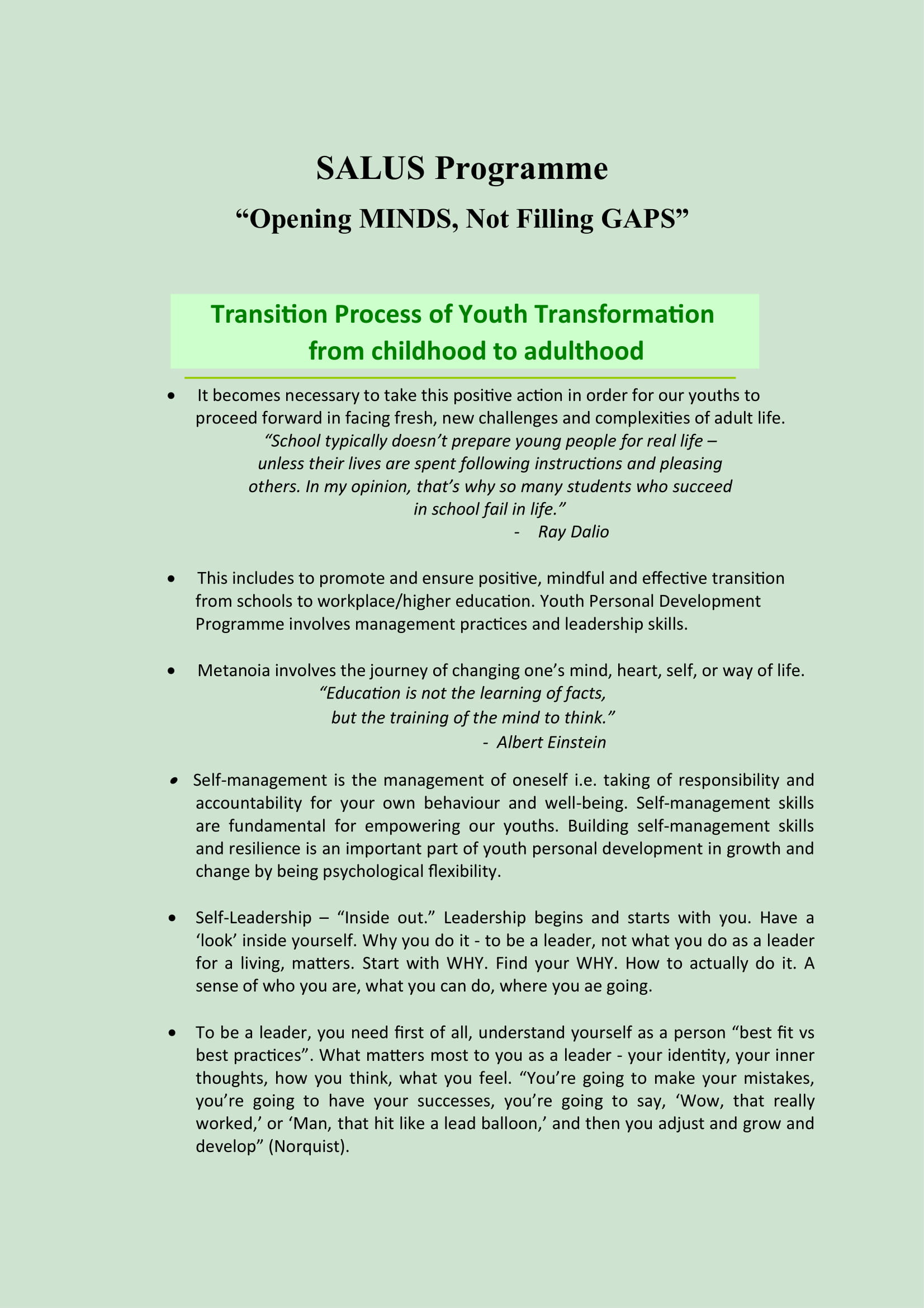
- Transition Process of Youth Transformation from childhood to adulthood
- Adventure and Outdoor / Indoor Camping
“Believe in yourself! Have faith in your abilities! Without a humble but reasonable confidence in your own powers you cannot be successful or happy.”
– Norman Vincent Peale
SALUS Programme: After your SPM, so what happens after this?
“Opening MINDS, Not Filling GAPS”
A plethora of a thousand and one questions arises after your SPM (Sijil Pelajaran Malaysia) as school leavers – unexpected, uncertainty, unsure – what do you do? Where do you go? What do you want? How to deal and cope with change as school-
leavers, moving from school to work/colleges? Only you know the answers to the questions you yourself have raised by focusing your attention within for “let him who would move the world, first move himself” (Socrates). Ask yourself – what is going on inside you at this moment? The greatest and most difficult obstacle you face is “yourself” for you have a tendency to react in ways that do not actually serve your interests. It is important to find and seek within yourself – all the barriers and obstacles that you have instill and build against it. What must be done will be done, regardless of what it takes.
“You can, you should; and if you’re brave enough to start, you will”.
– Stephen King
First and foremost, you have to find your pathways and insights in personal development in knowing yourself “I am nothing….and everything” as the foundation and groundwork that can help you to thrive inwardly in preparation of life after school by transforming barriers to frontiers. You must be willing to let yourself be open to have self-discovery and to sense and find your “Why”. You have to find your “WHY” – why you do what you do? Why you must master yourself in discovering your own sense of purpose? What is your story? How you feel about it? Why?
“Realize that you are simultaneously everything and nothing –and decide what you want to be”.
– Ray Dalio
The 2day Training Workshop aims to take you through the journey to spark self-discovery for “the only journey is the journey within” (Rainer Maria Rilke) in finding your inner spark – your character strength, passion, talents, potentials. We are here not to try to convince or to change you. You have the choice within yourself to make
change and inspire to discover who you are. We would like to be part of your initiative in personal aspects of change. Transition stage of development – from school to work/colleges/universities, are the critical period of change and when wellbeing is most crucial. You need to have the chance and opportunity to get heard and it is the starting point of finding your “WHY”. The training provides invaluable guidance and insights of your innermost self by examining your own internal thoughts and feelings and reflecting on what these thoughts and feelings mean. What matters is that you are in charge. How you see yourself? How to see yourself clearly?
“It is not what happens to us but how we react to it that defines who we are”.
– Epictetus
When you want to make change in your life, you are often faced and challenged by resistance, whether internal resistance that occurs within yourself or external resistance that occur within your family, friends and people. Ongoing, continuous process of change is an integral part of development in the growing-up years. In order for you to grow as a person, you have to be willing to accept change. How you can instigate change within yourself – how you can make what you do; how you do it effectively and successfully. You need to observe, notice and aware of what is happening within your own selves that need to be changed. You cannot change what you do not notice. You do not have to make immediate or drastic change. You need to break change down into smaller chunk and steps rather than finding the whole complete change and transform overnight. You need time to understand the change process happening within yourself. You need to practice, practice and practice, till the skills become part and parcel of yourself, i.e. who you actually are? “Why” is who
you are. Only then, change takes place.
“Let us not look back in anger or forward in fear, but around in awareness”.
– James Thurber
Attend the practical training workshop with an open heart and mind as a worthy endeavor for you find it hard and difficult to make sense of what you want, think or feel. The training aims to help you as school leavers grow as a person and also help you better yourself. We are better when we open up and share our thinking and emotions than when we think and feel alone. Let the process of self-discovery be revealed to you, in a practical, real-life experiences as in the 5-step process of self-reflection and planning:
– Who do I want to be?
– Who am I now?
– How do I get from here to there?
– How do I make change stick?
– Who can help you?
“Work hard for something we do not care about is called STRESS.
Work hard for something we love is called PASSION.
We cannot change our lives until we change our MIND
Minds are like parachute; if they are closed, they would not hold us up.
Opening MINDS, Not Filling GAPS.
– Dr S H Lua
For further information, please kindly contact Fiona at 017 6368970 / 012 9011338
Download: SALUS Programme: After your SPM, so what happens after this?
Public Training Programmes (PTP) under HRDF SBL- Khas Scheme (HRDF Claimable)
We are pleased to announce that Applied Positivity Enterprise Sdn Bhd as HRDF Training
Provider, will be organizing a series of 2-day Acceptance and Commitment Training
(ACTraining) Process-based Optimal Wellbeing Training Workshops based on Acceptance
and Commitment Therapy (ACT):
(1) Experiential ACT Wellbeing Training in the Workplace
To acquire basic knowledge of ACT core processes and its underlying theory
(Relational Frame Theory)
To acquire effective skills to deal and cope with thoughts, feelings and behaviours
To enhance positive mental health, psychological wellbeing and resilience
(2) ACT Wellbeing Skills Development and Engagement in the Workplace
To apply ACT Wellbeing Skills into evidence-based practice in the workplace
To utilise ACT proven strategies and skills to be positively engaged in the workplace
To sustain positive change in fulfilled and meaningful life, personally and professionally
(3) Acceptance and Commitment Training ( ACTraining ) in the Workplace: Developing Psychological Flexibility Skills
To improve performance and reduce stress and burnout at work
To focus on improving development of psychological flexibility and engagement in the workplace
To understand the principles of ACTraining and Psychological Flexibility by application of ACT model in the workplace
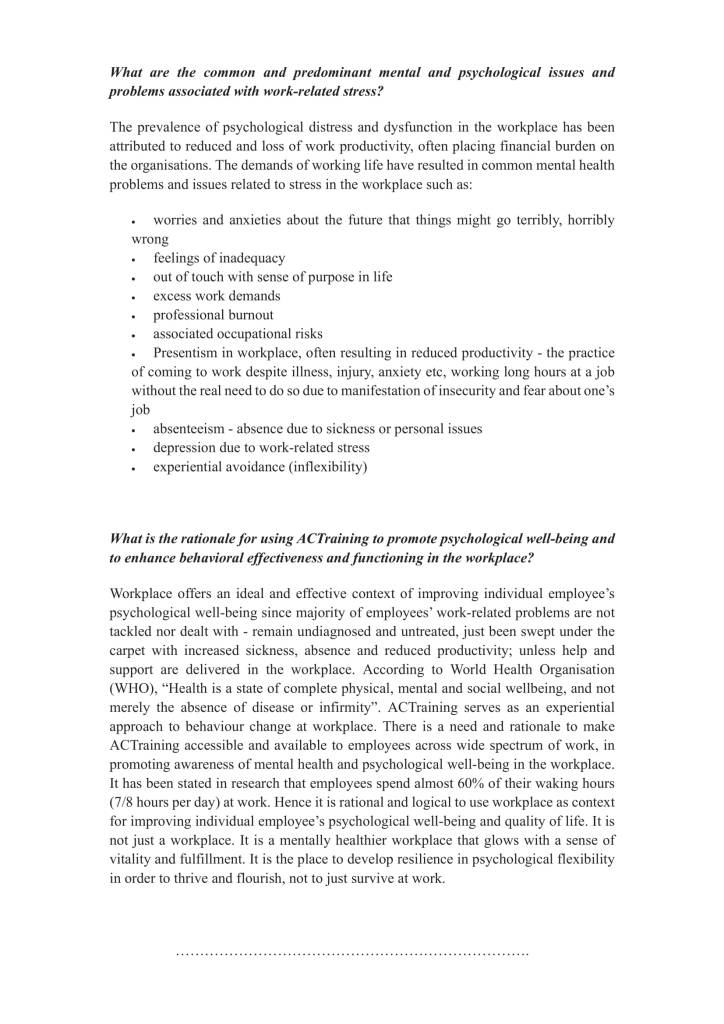
Come and experience of what it is like experientially to do ACT in a real context hands-on practice and feedback- “I hear and I forget. I see and remember. I do and I understand.” ACT is a practical functional contextual approach in helping and guiding you to cultivate psychological flexibility and engagement in the workplace. In these workshops, you will learn and obtain positive and engaging experience and gain the ACT skills which give a sense of vitality, meaning, flourish and fulfillment in the workplace. Get your act together by attending ACT workshops. Acceptance and Commitment Therapy (ACT) is part of the ‘third wave’ cognitive behavioural therapies (CBT) with strong evidence base. ACT focuses on values and context in promoting optimal wellbeing in the workplace.
For registration and further information, please kindly contact Ms Fiona at 017 6368970 /
012 9011338.
Download: Public Training Programmes (PTP) under HRDF SBL- Khas Scheme (HRDF Claimable)
National Conference on Mental Health and Wellbeing @ Work
Why does it matter?
Applied Positivity Enterprise Sdn Bhd plans to join forces with the Human Resource Development Fund (HRDF) Malaysia to create an awareness of mental health and wellbeing in the workplace as we share a common work focus and concerns. Can we do something about it? Yes, we can. It is a worthy endeavor to organize jointly with HRDF – National Conference on Mental Health and Wellbeing @ Work based on the World Mental Health Day presented by the World Federation of Mental Health to ‘increase awareness about mental health and the importance of mental health in overall health of a person.” The goal and objective of National Conference on Mental Health and Wellbeing @ Work is to help raise mental health awareness in workplace and to promote proactive strategies rather than reactive strategies in resilience and coping skills for employees to deal with pressures and stresses in the workplace so that they do not just merely surviving but thriving and flourishing at work.
We must focus more on employees in creating awareness of them as a ‘person’ – their needs, worries, anxieties, fear i.e. how they feel, think and behave, as they navigate new challenges and opportunities in the workplace. If employees believe in themselves as a ‘person’ – knowing thyself in acquiring the way they understand themselves and their relationships (soft skills) which is the root of everything they do in life, they can accomplish great things in their productive work and “the so-called soft side of business begins to look not so soft after all” (Goleman & Boyatzis).
Understanding and creating an awareness of mental health and wellbeing is one of the central challenge in the 21st century as we need to shake off the stigma of negativity associated with mental health and to explore the implication of mental health in the workplace. We have been continuously focused on economic and industrial development, often at the expense of employees’ mental health and wellbeing. To quote Geoff Mulgan (2007), “Wellbeing will be the major focus of government in the twenty-first century, in the way that economic prowess was in the 20th and military prowess in the nineteenth.” Mental health and wellbeing issues exit and occur everywhere and anything related to reality in the 21st century in the best of time and in the worst of time – at workplace, at home, at schools.
It is the right steps and timing, now in the 21st century to address and acknowledge the hidden problems of mental health issues in the workplace which has been a taboo for a long time and therefore the need to break the ‘wall of silence.’ To put it bluntly, ‘mental health is stigmatized’ even though mental health issues are often an open secret. 1 in 4 working adults have experienced mental health problems. All of us have known someone in the family or people at work that have gone through mental illness in their life. We should accept mental health as part and parcel of our wellbeing especially during the midst of life significant transitions such as career shifts, position change, unemployment and what keep them at work. It is our duty and we have a responsibility to better educate employees to acquire soft skills (intrapersonal and interpersonal) in creating awareness of mental health and wellbeing at work.
We can develop understanding and expertise in our collaboration and partnership in jointly organising HRDF National Conference on Mental Health and Wellbeing @ Work that includes (i) keynote presentations; (ii) a series of training workshops presentations; and (iii) professionals dialogue sessions. We hope we will be able to challenge all of you to think very differently and laterally in a new light – in a positive ways and perspectives about mental health and wellbeing @ work. We would like to take these ideas forward and to discuss our thoughts on mental health issues in the workplace and to explore together the possibilities of jointly organising the National Conference on Mental Health and Wellbeing @ Work. What we are trying to achieve is just a starting point whereby we do the best we could, we do what we can, as best as we can, hoping that the best we can do is good enough in making and creating opportunities for we do not just wait for the opportunities to come.
Download: National Conference on Mental Health and Wellbeing @ Work
Leadership Development Training: Unleashing Inside-Out Leadership Skills
Type of Training Programme
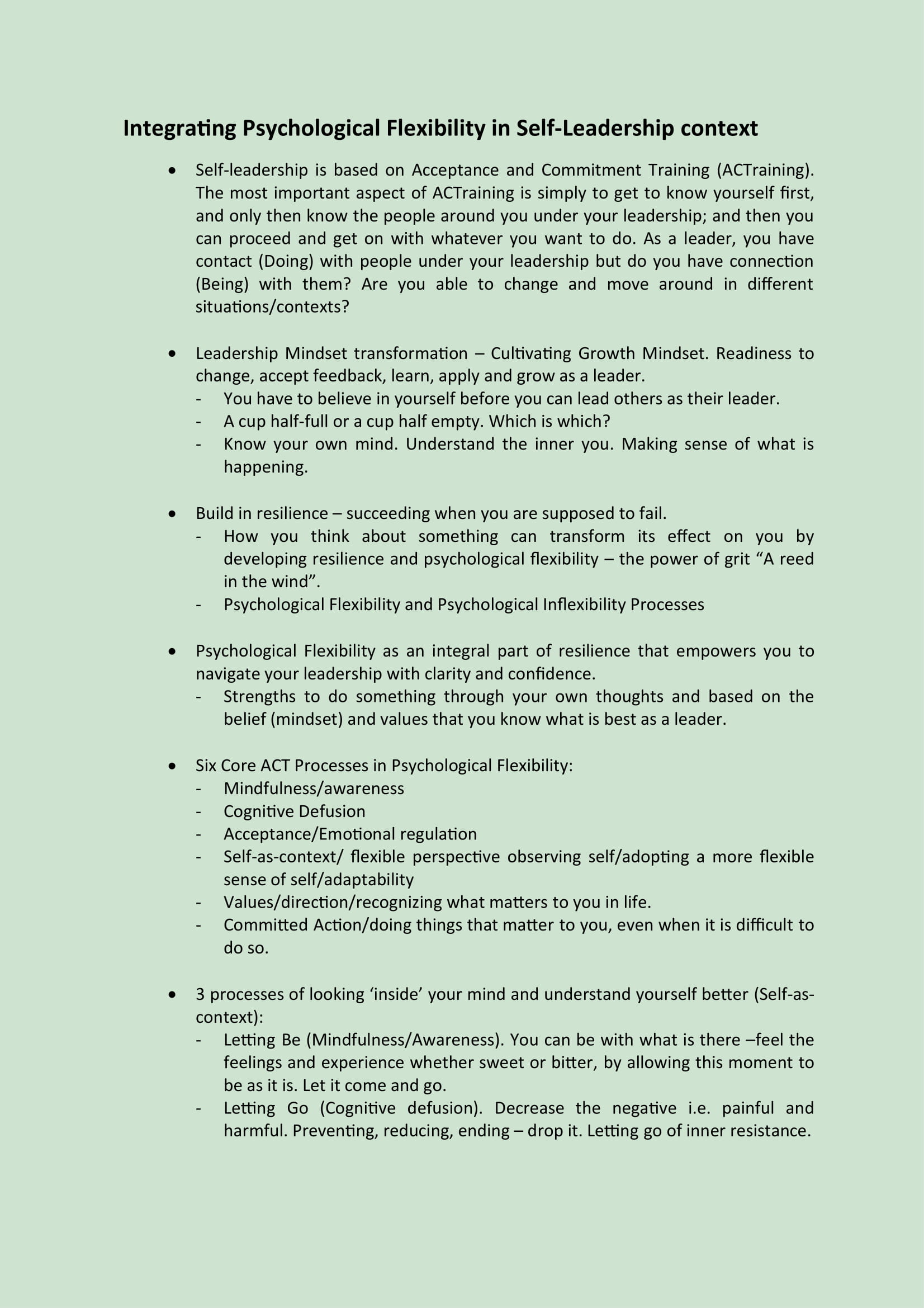
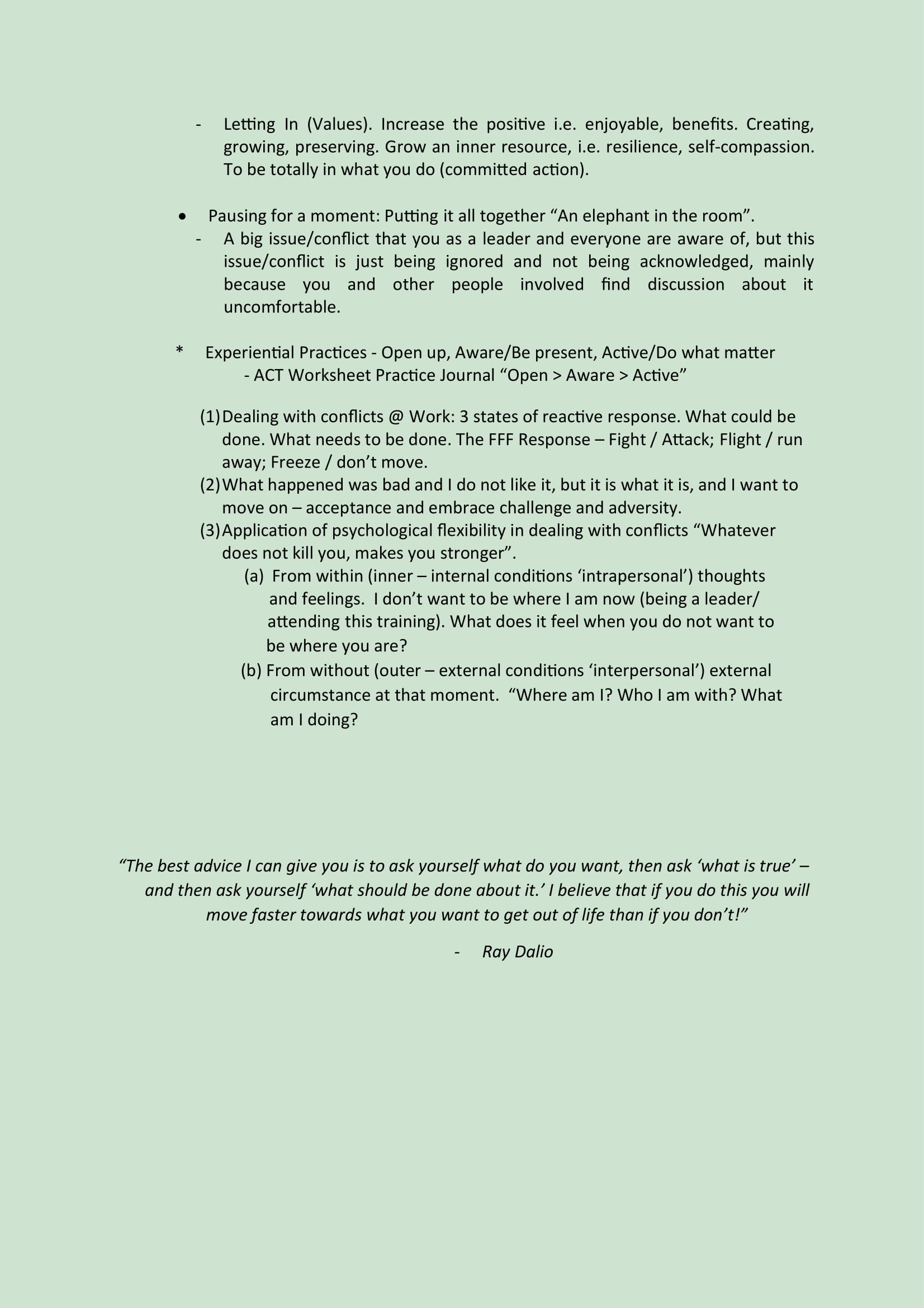
Management is not just for managers, leaderships not just for leaders. We all manage, and we all lead as we progress through our life. Self-management is the management of oneself i.e. taking care of responsibility for your own behaviour and well-being. Self-management skills are fundamental for empowering us in whatever capacity we are functioning. The training is a masterclass programme, building on your knowledge and experience as a leader and challenging what you know and think about leadership. This comprehensive masterclass Leadership Development Training Programme is not about how to lead, what are good leadership criteria etc. which you have already acquired in your job role as a leader. This masterclass Leadership Development Training Programme is all about your own leadership of yourself as a wholesome person – the inside-out leadership development processes of how you as a leader develop – what are your inner resources and strengths that lie within which enable you to thrive as a leader under pressure including your self-esteem, self-confidence, self-compassion – all about your innermost self that will make or break you as a leader. The Masterclass Leadership Development Training Programme serves as an integral part of the MBA elective module pathway to develop personal leadership skills and is HRDF (Human Resource Development Fund) registered training programme.
Training Objectives
We are going to set aside some time for a process of self-inquiry during the 2-day in-person training simply to hear one another, to share insights on influential leadership and allow opportunity to talk about our leadership experiences in the driver’s seat of our own leadership path “Lead with storytelling” – What we care about? What we want to talk about? What are our personal frustration of no one ever wants to hear our stories/views? Then we will begin reflecting and discussing evidence-based ACTraining (Acceptance and Commitment Training) where we could all come together to a bigger story at the heart of our leadership development in opening a floodgate of thinking/emotions and meaning/ purpose – an ongoing continuous journey of a never-ending puzzle filled with precious jigsaw pieces. Will we find transformation? How will we become fully alive, mindful and effective as a leader? Where will we find hope and
opportunities for change amidst our emotional vulnerability and conflicts? Minds are like parachute. If they are closed, they would not hold you up. Opening up inwardly in yourself, you will find you possess exactly what it is you desire as a leader. The training sessions itself will be FUN: F = Freely, U = Unselfconsciously/Unconditionally, N = Naturally.
Skills Area
- To develop and manage yourself as a person and improve your self-confidence, self-esteem and self-compassion – “Lead Yourself First – Inside Out.”
- To cultivate a growth mindset that serves as a framework of leading change that you would like to be and work on adjusting and adapting to diversity and differences – “Springboard change of minds, hearts and behaviour.”
- To acquire psychological flexibility skills based on six processes of ACT approach
(Acceptance and Commitment Training) to be ingrained in every aspect of resilience training process to turn adversity/challenge into a resource of practicability and workability – “A reed in the wind”. - To have an impact on Positive Change Transformation and Self-empowerment in value-based leadership – “Benefit finding in positive consequences of negative events.”
- To gain insights of self-leadership, giving a sense of vitality, meaning and fulfilment – your sense of perspective as a leader “Something you do with people, not to people.”
Duration
A 2-day in-person Training Workshops
Target Group (by designation)
Executives
HR Directors
Leadership coaches
Managers
Team Leaders
Supervisors
Headmasters / Teachers
Youth
MBA Course / related courses
Targeted Industry/Industries for the course
Public and Private Organisations
MBA Course Elective Module
Leadership Training “Train-A-Trainer”
Personal Development for youth, headmasters/teachers and employees
Certification (please state the certification body if applicable and the supporting body).
Certification Training – Certificate of Attendance
Continuing Professional Development (CPD)
Related Course Certification
Training Facilitator:
Dr. S.H. LUA
For more than three and half decades, Dr S H Lua has continuously brought enthusiasm, positive insights, passions and mindful compassion in her work as applied psychologist and trainer – working in practice is what really matters “Walk the Talk” with professionalism and integrity. She also holds post-qualification British Psychological Society Register of Applied Psychology Practice Supervisors (RAPPS). She strongly believes in hands-on, well-informed, pragmatic and value-based leadership approach in prime the pump – taking action and making good things happen. She is committed in promoting and advancing psychological wellbeing within inclusive practice. She is a passionate advocate of Psychological Wellbeing ACTraining (Acceptance and Commitment Training) in the workplace, as the saying goes, ‘Give a man a fish, and you feed him for a day. Teach a man to fish, and you feed him for a lifetime.’ As an ACTraining Facilitator and HRDF Certified Trainer, her objective in developing leadership mentality is to ‘open the door for you, not only to realize that the door has been unlocked but you must walk through it yourself since you need to sense what is going on beneath the surface of yourself for ‘knowing is not enough, you must apply; willing is not enough, you must do.’ She strongly believes that ACTraining needs to be more accessible and available to Leadership Development Training Programme as part of occupational mental health policy and practice.
Download: Leadership Development Training: Unleashing Inside-Out Leadership Skills
SALUS Programme: Transition from Lower Secondary to Upper Secondary Level “Inner Strength Training”
“Opening MINDS Not Filling GAPS”
2-day Skill Training Workshop
Time: 9am – 4pm
Participants: Teens / adolescents – Form Three Students and Form Four Students
It is important to acknowledge that our young people (teens/adolescents) are not succeeding in their learning due in lacking: (i) character strength (inner within oneself); and (ii) supportive social context. Positive behaviour mediates the link between character strengths and academic achievement. When our young people are at their transition stage of development, they are often at a crossroads in their life. It is important to support and promote personal development and growth in optimal functioning and wellbeing based on positive psychology in harnessing the power of happiness, mindfulness and inner strength (Segal and Leighton), learned optimism (Seligman), and positivity (Fredrickson). Character strengths are trainable personal characteristics and skills to improve coping with work-related stress and to decrease the negative effects of stress.
What is DNA-V?
- DNA-V stands for:
– D for Discoverer
– N for Noticer
– A for Advisor
– V for Value and Vitality - DNA-V is a model of acceptance, mindfulness and positive psychology
- DNA-V Model (developmental model of Acceptance and Commitment Therapy) in building character strengths, responsibility/accountability and wellbeing. DNA-V is a simple way of helping young people learn about the skills they have inside them – inner power within yourself. What is most important to you?
Learning Objectives:
- To help and empower teens/adolescents manage their growing sense of self:
– Difficult thoughts, feelings (emotions)
– achieve their strengths and potentials
– build social connections - To provide a springboard for young people to discuss their strengths, needs and interests in acquiring psychological flexibility and character strength.
- To help young people acquire practical skills in coping and struggling for identity in
adolescence to flourish and thrive in schools - To enable young people to be flexible in choosing the behaviour that best fits the
situation (context) and circumstances (content/event) that influence behaviour. - By changing and making the Inner experience more positive in order to be optimal functioning
- To discover and identify their character strengths and potential that lies within themselves.
- To promote positive education using positive psychology in resilience, positive
emotions, engagement in their learning, meaning (values), curiosity, social
connectedness. - To introduce our young people to their DNA-V
Learning Outcomes:
- Young people will grow into strong and healthy
- Practical skills to flourish and thrive in schools
- Address a variety of life challenges
- Achieve positive personal outcome using character strengths
“With everything that has happened to you, you can either feel sorry for yourself or treat what has happened as a gift. Everything is either an opportunity to grow or an obstacle to keep you from growing. You get to choose.”
– Dr Wayne W Dyer
Download: SALUS Programme: Transition from Lower Secondary to Upper Secondary Level “Inner Strength Training”
 Applied Positivity