
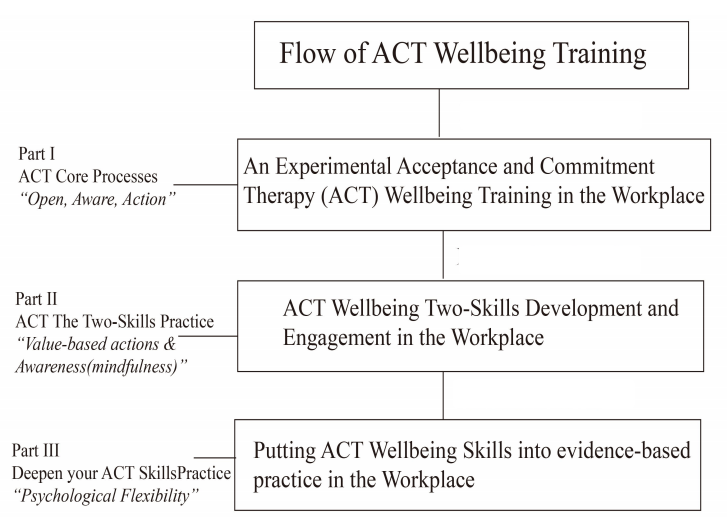
The three parts ACT protocol framework of training in the workplace provides an opportunity for participants to return and share their experiences of practice and skill application. ACT has been adapted to create a non-therapy version called Acceptance and Commitment Training to train and teach awareness (mindfulness), acceptance and value skills in non-clinical setting such as workplace (Hayes et al 2007); as the saying goes, “ Give a man a fish, and you feed him for a day. Teach a man to fish, and you feed him for a lifetime”.
What is Acceptance and Commitment Training( ACT )?
(ACT, pronounced as the word ‘act’)
ACT has the potential to promote and improve the work site mental health by application of psychological flexibility rather than using reactive approach of symptom reduction. ACT training programme is designed as a generic employee wellbeing skills training programme.
- ACT serves as work site stress management training in experiential approach
to behaviour change - ACT is applied not to change the form, intensity, frequency of undesirable
thoughts and feelings but instead, to change how employees respond or relate to
their internal events (thoughts and feelings) in order to live meaningfully – ‘open,
aware, and active” lives. - ACT is adapted into a group-based training programme (Flaxman et al) to
facilitate and cultivate the functional psychological and behavioral two-skills of
(1) awareness (mindfulness); and (2) values-based action; in non therapeutic
situations. - ACT is developed within a pragmatic philosophy called functional
contextualism with emphasis that psychological well-being is determined by how
the thoughts (cognitions) interact with the contexts/situations/environments either
to help or hinder the ability to pursue values and goals. - ACT needs to be more accessible and available to employees as part of
occupational health policy and practice. - ACT is based on the nature of human language and cognition (Relational
Frame Theory – RFT), i.e. a comprehensive theory of language and cognition
derived from behaviour analysis. - ACT teaches and trains individual employees to be aware (just notice), accept
and embrace their private events including the unwanted thoughts, feelings;
whereas traditional cognitive behaviour therapy (CBT) places emphasis on
teaching individuals to better control their thoughts, feelings, sensations,
memories and other private events. - ACT helps and enables individual employees to get in contact with a
transcendent sense of self known as “self-as-context”. This means that the YOU,
always there observing and experiencing and yet distance from one’s thoughts,
feelings, sensations and memories. - ACT assumes that psychological processes of a normal human mind are often
destruction (Harris, R. 2006) – psychological suffering; rather the ‘healthy
normality” where by their nature, the processes of human mind are
psychologically healthy. - Psychological suffering is caused by experiential avoidance, cognitive
entanglement (cognition fusion) which then result in psychological rigidity that
leads to a failure to take needed behavioral actions according to values and goals.
What is the objective of ACT?
According to Hayes et al (2012), the objective of ACT is not elimination of difficult feelings; rather, it is to be present with what life brings us and to move towards valued behaviour. ACT Experiential Training Workshops allow participants to “open up to unpleasant feelings, and learn not to overreact to them, and not avoiding situations where they are invoked. Its therapeutic effect is a positive spiral where feeling better leads to a better understanding of the truth” (Shpancer, 2010). ACT aims to help individual employees to clarify their personal values and to take action on them (goal-directed behaviour), bringing more vitality and meaning to life, in the process, hence increasing their psychological flexibility (Zettle, 2006)
Why is it important to improve your psychological well-being in the workplace?
Based on functional contextual development model, ACT has significant contribution and beneficial effects to workplace well-being:
- positive mental health and psychological well-being
- to maximize behavioral effectiveness i.e. performing well at work
- job satisfaction
- leadership development – to develop crisis-resilient change
- quality of work life and fulfillment
- emotional resilience
- positive and good organisation behaviour management strategies and
initiatives such as team and leadership development and career coaching - acceptance (flexibility) to experience unwanted private events instead of
altering the form, frequency or sensitivity, in the pursuit of values and goals - psychological flexibility (ACT’s core psychological process) – ‘the ability to
fully contact the present moment and the thoughts and feelings. ACT training has
been found to be useful on a personal level – knowledge and experiential training
gained during the group format training have been useful to participants in their
own life
What are the common and predominant mental and psychological issues and problems associated with work-related stress?
The prevalence of psychological distress and dysfunction in the workplace has been attributed to reduced and lost of work productivity, often placing financial burden on the organisations. The demands of working life have resulted in common mental health problems and issues related to stress in the workplace such as:
- worries and anxieties about the future that things might go terribly, horribly
wrong - feelings of inadequacy
- out of touch with sense of purpose in life
- excess work demands
- professional burnout
- associated occupational risks
- Presentism in workplace, often resulting in reduced productivity – the practice
of coming to work despite illness, injury, anxiety etc, working long hours at a job
without the real need to do so due to manifestation of insecurity and fear about
one’s job - absenteeism – absence due to sickness or personal issues
- depression due to work-related stress
- experiential avoidance (inflexibility)
What is the rationale for using ACT to promote psychological well-being and to enhance behavioral effectiveness and functioning in the workplace?
Workplace offers an ideal and effective context of improving individual employee’s psychological well-being since majority of employees’ work-related problems are not tackled nor dealt with – remain undiagnosed and untreated, just been swept under the carpet with increased sickness, absence and reduced productivity; unless help and support are delivered in the workplace. ACT serves as an experiential approach to behaviour change at workplace. There is a need and rationale to make ACT accessible and available to promote mental health and psychological well-being in the workplace. It has been stated in research that employees spend almost 60% of their waking hours (7/8 hours per day) at work. Hence it is rational and logical to use workplace as context for improving individual employee’s psychological well-being and quality of life.
We specialise in providing:
- ACT Wellbeing Training Workshops in the workplace
- ACT for Management Levels
- In-house, tailor-made ACT Wellbeing Training Programmes
- Intensive Focused Acceptance and Commitment Training (FACT) to fit in
time demands
Acceptance and Commitment Training (ACT) is:
- Fun
- Interactive
- Experiential
- Real work practice to develop the psychological skills that employees need to function effectively and productively at work
“ It’s not hard to make decisions when you know what your values are”
– Roy Disney
 Applied Positivity